Why Are Handmade Plush Toys More Expensive in China?

Time:2026-10-03 Author:Sophia
0%

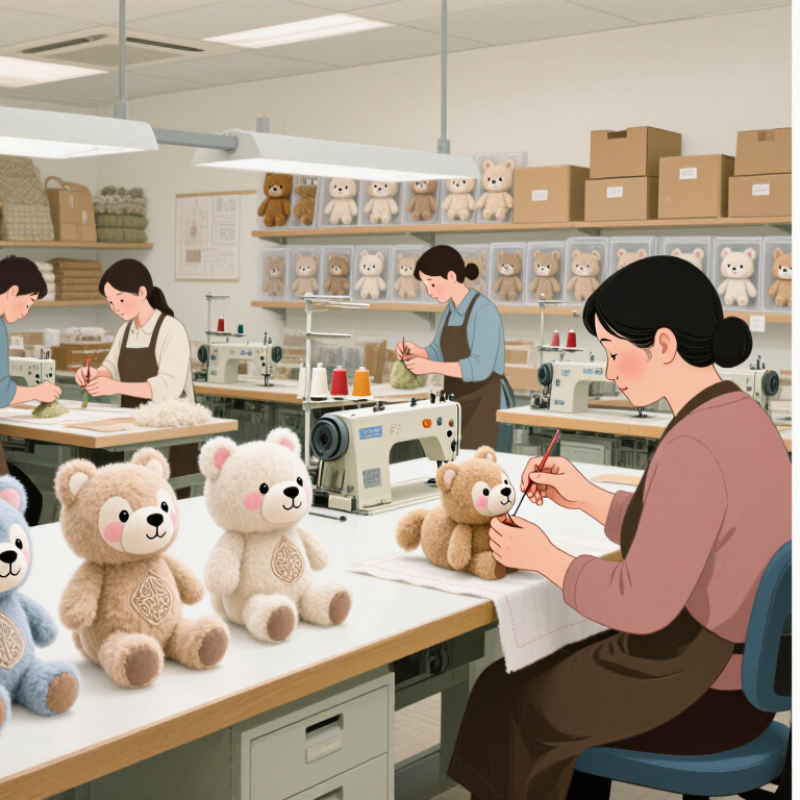
When shoppers see a handmade plush toy made in China, the price can seem surprising. China is widely associated with efficient manufacturing and affordable goods. Yet handmade production follows a different economic logic. Each toy may involve fabric selection, pattern cutting, stitching, stuffing, shaping, embroidery, and final inspection. These steps require time, patience, and skilled hands.

This article explores why are handmade plush toys more expensive through the realities of small-batch production. A workshop producing twenty toys cannot spread design, sampling, equipment, and packaging costs across thousands of units. A maker may spend hours correcting uneven ears, adjusting the filling, or hiding a thread beneath a seam. Material choices also matter. Organic cotton, soft recycled fibers, embroidered details, and child-safe components can raise the total cost. Quality control, product testing, and reliable packaging add further expenses.

The answer is not perfectly neat. Some expensive toys reflect genuine craftsmanship, while others may simply carry strong branding. Prices can also vary between regions, workshops, and order sizes. That deserves scrutiny. Comparing stitch quality, material labels, labor time, and after-sales support offers a more dependable assessment than judging the price alone. Industry experience suggests that handmade value is visible in consistency, durability, and thoughtful finishing. Still, buyers should ask clear questions about materials and production methods. A high price is not automatic proof of superior quality. This introduction will examine the labor, materials, design risks, and business costs behind China’s handmade plush toy market, helping readers make more informed purchasing decisions.
Why Are Handmade Plush Toys More Expensive in China?

What Defines a Handmade Plush Toy in China?

In China, a handmade plush toy is not defined by a completely hand-sewn body. It is defined by meaningful human work during key production stages. A craftsperson may select fabric, cut curved pieces, shape the face, fill the body, and adjust the final expression by hand. Machines can still handle repetitive stitching. That distinction is often misunderstood.

The China Toy and Juvenile Products Association reported that China’s toy exports exceeded US$30 billion in 2023. Large-scale production therefore uses efficient equipment, even for customized plush products. Handmade value appears in the slower decisions: matching fabric direction, checking embroidery tension, and correcting uneven stuffing near the ears or paws. Small flaws can remain.

That is not always a weakness.

A handmade item should also show process evidence. Buyers can request sample photos, stitching details, filling descriptions, and inspection records. ISO 8124-1 provides internationally recognized guidance for toy mechanical and physical safety, but it does not certify a toy as handmade. Safety testing and craftsmanship are separate questions. Grand View Research’s 2024 stuffed toys market report projects continued global growth, partly supported by personalization and gift demand. Yet higher demand can pressure workshops to call semi-automated products “handmade.” The term needs careful verification. A loose thread may reflect human finishing, or poor quality control. Experience helps, but documentation matters more.

How Skilled Craftsmanship Shapes Production Costs

Handmade plush toys can cost more in China because skilled craftsmanship requires time, patience, and repeated inspection. A worker may hand-cut fabric, match curved panels, and stitch small details with careful tension. One uneven seam can change a toy’s expression. That detail matters.

Experienced makers also control stuffing density by touch. Too little filling makes the body collapse. Too much filling distorts the shape and stresses the seams. Embroidered eyes require steady positioning, while tiny ears may need several adjustments. These tasks are slower than automated production, especially for small orders. Labor is only one cost. Sample development, pattern corrections, material waste, and quality checks also increase the final price.

Tips: Ask how many hand-finishing steps each toy receives. Request close photos of seams, embroidery, and stuffing. Confirm whether sample revisions are included in the quotation. A low price can hide rushed assembly or frequent rework. However, higher cost does not guarantee perfect quality. I have seen beautifully stitched samples fail because their fabric changed during production. Clear specifications and physical inspections remain important. Even skilled workshops can make mistakes when instructions are vague, timelines are compressed, or unusual shapes require new techniques.

Why Are Handmade Plush Toys More Expensive in China? - How Skilled Craftsmanship Shapes Production Costs

Indicative Production Cost Benchmark for a 30 cm Handmade Plush Toy in China
Cost Dimension Typical Work Involved Skilled Labor Time per Unit Indicative Cost per Unit (CNY) How Craftsmanship Raises Cost
Fabric and Filling Cutting plush fabric, selecting suitable pile direction, and preparing polyester filling. 3–8 minutes ¥12–24 Higher-pile fabrics, multiple fabric colors, and low-waste cutting increase material usage and preparation time.
Pattern Cutting and Preparation Tracing, cutting small pattern pieces, matching mirrored parts, and preparing components for sewing. 5–12 minutes ¥6–16 Detailed silhouettes require more pieces and tighter alignment tolerances than simple round or tubular shapes.
Precision Sewing Sewing curved seams, narrow limbs, ears, facial parts, and concealed openings. 18–35 minutes ¥22–48 Complex curves and small components slow production and require operators with stronger sewing and shaping skills.
Hand Embroidery and Appliqué Adding eyes, mouths, decorative lines, patches, or layered fabric details by hand. 8–20 minutes ¥8–25 Each stitch or appliqué layer requires manual positioning, visual checking, and correction when alignment is uneven.
Stuffing and Shape Formation Filling the body, distributing stuffing evenly, closing openings, and shaping the final form. 5–12 minutes ¥5–12 Hand shaping creates a softer, more individualized result but takes longer than standardized machine-assisted filling.
Final Assembly and Finishing Attaching limbs and accessories, trimming loose fibers, correcting seams, and checking symmetry. 5–12 minutes ¥7–18 Manual finishing reduces visible defects but adds inspection and rework time to every unit.
Quality Control and Rework Checking dimensions, stitching, facial placement, filling density, and attachment strength. 3–7 minutes ¥3–9 Products with handmade details require more visual judgment because variation cannot be measured only by machine settings.
Packaging and Handling Folding or shaping, inserting care information, protecting delicate details, and packing individually. 2–5 minutes ¥3–8 Irregular shapes and protruding decorations often require slower packing to prevent deformation or damage.
Factory Overhead and Production Support Supervision, equipment maintenance, workspace, utilities, pattern adjustments, and production coordination. Not directly allocated ¥8–20 Small-batch handmade work spreads fixed setup and supervision costs across fewer units.
Estimated Production Cost Total Typical small-batch production with manual sewing, detailing, shaping, and inspection. 49–111 minutes ¥74–180 The final cost is mainly shaped by labor intensity, design complexity, batch size, material selection, and rework requirements.
Benchmark notes: Figures are indicative production-cost ranges in Chinese yuan for a 30 cm plush toy, based on a small production batch of approximately 500–1,000 units. They exclude tax, international freight, certification, licensing, and retail markup. Actual costs vary by region, order quantity, design complexity, material quality, and required safety testing.

Why Materials and Small-Batch Production Increase Prices

Why Are Handmade Plush Toys More Expensive in China?

Handmade plush toys cost more because materials are purchased in smaller quantities. A workshop may order only 50 meters of fabric, not several tons. Suppliers then offer fewer volume discounts. IMARC Group’s 2024 market report identifies polyester as a major plush-toy material, but prices still vary with fiber quality, density, dyeing, and certification requirements. Soft fabric is not always cheap fabric.

Small-batch production adds another layer. Each toy may need cutting, stuffing, stitching, shaping, and inspection by hand. Workers also adjust patterns when the first sample feels unbalanced. China’s National Bureau of Statistics reports rising manufacturing labor costs over recent years, which affects labor-intensive products directly. The effect is easy to miss. A ten-minute correction can become a real cost across many pieces.

Packaging and testing matter too. The China Toy and Juvenile Products Association has reported continuing demand for safer, higher-quality toy products, increasing inspection and documentation work. A handmade toy may use embroidered details, thicker thread, or custom stuffing. These choices improve touch and durability, but they consume time. I have seen buyers compare only fabric prices, while ignoring rejected pieces and setup hours. That calculation is incomplete. Small orders can look simple, yet every fixed cost is spread across fewer toys. Some workshops may also price cautiously, because handmade production has more unpredictable waste. That caution is not always perfectly measured.

How Labor, Quality Control, and Customization Affect Value

Why Are Handmade Plush Toys More Expensive in China?

Handmade plush toys reflect labor, inspection, and customization costs. China’s National Bureau of Statistics reported average annual wages of 69,476 yuan in private urban units in 2024. Skilled sewing requires more time than factory stitching. Workers check seam strength, stuffing density, facial alignment, and loose threads by hand. Each correction adds minutes, but small orders cannot spread those minutes across thousands of pieces.

Quality control also affects value. The American Society for Quality notes that poor quality can consume 15–20% of sales in many businesses. For plush toys, one failed sample may require fabric replacement, pattern changes, or repeated safety checks. Handmade does not automatically mean better. An uneven stitch may show character, or weak control. Buyers should ask which details are intentional. Customization adds another layer. McKinsey’s 2021 personalization research found that 71% of consumers expect personalized interactions, while 76% feel frustrated without them. A custom color, name, or expression requires separate artwork, approval, cutting, and inspection. The price pays for coordination, not only materials.

Tips: Request a written sample standard. Confirm fabric composition, stuffing weight, embroidery placement, and acceptable stitch variation. Ask for inspection photos before final production. A cheaper quote may hide extra revisions, inconsistent sizing, or longer delivery time. Allow a small tolerance, but define it clearly.

Why Are Handmade Plush Toys More Expensive in China?

Relative cost index by value driver — mass-produced plush toys = 100

Handmade plush toys generally cost more because labor-intensive sewing and finishing require more time per unit. Small-batch quality control adds inspection and rework costs, while customization increases expenses through pattern changes, sample approvals, special fabrics, and individualized details. The index is a non-brand planning benchmark; actual quotations vary by design complexity, order quantity, materials, and production location in China.

How Market Demand and Retail Channels Influence Final Prices

Why Are Handmade Plush Toys More Expensive in China?

Market demand strongly shapes handmade plush toy prices in China. The China Toy and Juvenile Products Association reported toy retail sales of 90.7 billion yuan in 2023. Collectors increasingly seek small-batch designs, custom expressions, and visible hand-stitching. These details create scarcity, but they also require more labor per item.

The retail channel changes the final price. China’s National Bureau of Statistics reported that online physical-goods retail sales grew 8.3% in 2023.

Online stores can reach niche buyers nationwide, yet sellers pay platform fees, advertising costs, packaging expenses, and delivery charges. Offline boutiques add rent and display costs. Direct workshops may offer lower prices, but their production capacity is limited.

Demand is uneven. Very niche.

A popular seasonal character can sell quickly, while a similar design may remain unsold. This risk encourages makers to include unsold inventory and testing costs in each price. Research from Statista Market Insights also shows China’s e-commerce market remains highly significant, increasing price visibility and buyer comparison. However, cheaper listings may use machine production, synthetic fabrics, or simpler filling. Comparing prices alone can mislead shoppers. Even experienced buyers cannot always verify every labor hour or material grade from photographs. That is where current pricing feels imperfect, and further transparency is still needed.

FAQS

What makes a plush toy handmade in China?

Meaningful human work defines it. A craftsperson may choose fabric, shape the face, fill the body, and adjust the expression. Machines may handle repeated stitching. It is not always fully hand-sewn.

Why can handmade plush toys cost more?

Skilled workers need extra time. They check seam strength, stuffing density, facial alignment, and loose threads. Small orders cannot spread these labor costs widely. Time matters.

Does handmade always mean better quality?

No. A handmade toy can still have weak stitching or uneven filling. Small flaws may show human finishing, but they may also indicate poor inspection. Buyers should ask for clear quality standards.

What customization details increase the price?

Custom colors, names, and facial expressions require separate artwork and approval. Workers must also cut, sew, and inspect each variation. A tiny embroidered name can require several extra checks.

How can buyers verify handmade production?

Request sample photos, stitching close-ups, filling details, and inspection records. Ask for production images before final manufacturing. Documentation is more reliable than attractive wording.

What should buyers check in a sample standard?

Confirm fabric composition, stuffing weight, embroidery placement, measurements, and acceptable stitch variation. Photograph the ears, paws, seams, and face. Details prevent later arguments.

How do sales channels affect the final price?

Online sellers may include platform fees, advertising, packaging, and delivery costs. Physical shops add rent and display expenses. Direct workshops may charge less, but capacity can be limited.

Why can similar plush toys have very different prices?

One may use slower hand finishing, better fabric, or denser filling. Another may rely more on machines and simpler materials. Photographs rarely reveal every labor hour. Price comparison remains imperfect.

Can a loose thread prove that a toy is handmade?

No. It may show human finishing, or weak quality control. One thread proves very little. Buyers need several kinds of evidence.

What risk comes with small-batch plush toys?

Makers may include unsold inventory, design testing, and revision costs. Seasonal demand can change quickly. A popular design may sell fast, while a similar one remains unsold.

Conclusion

Why are handmade plush toys more expensive in China? The answer lies in the time, skill, and attention required to create each piece. Unlike mass-produced toys, handmade plush toys often involve careful pattern cutting, stitching, stuffing, shaping, and finishing by experienced artisans. These steps allow for greater detail and individuality, but they also require more labor and specialized craftsmanship. Strict quality control further increases costs because every toy may be inspected for stitching strength, appearance, safety, and consistency.

Materials and production volume also influence the final price. Soft, durable fabrics, high-quality filling, and carefully selected decorative elements can cost more, especially when purchased in small quantities. Small-batch production offers flexibility for custom designs but provides fewer opportunities to reduce manufacturing expenses. Custom colors, shapes, embroidery, and other personalized features add additional labor. Finally, market demand and retail channels affect pricing, as transport, packaging, shop operations, and selling commissions may all be included in the final cost. Together, these factors make handmade plush toys valuable products rather than simple mass-market goods.

Sophia

Sophia

Sophia is a dedicated marketing professional with an exceptional depth of knowledge about her company's products and services. With a keen understanding of market trends and customer needs, she crafts insightful blog posts that not only inform but also engage readers, enriching the company’s online......