In 2026, shoppers are asking a sharper question: what are eco friendly plush toys made from? The answer usually involves recycled polyester, organic cotton, responsibly sourced wool, kapok fiber, or plant-based fabrics. Some toys use recycled PET bottles for soft filling. Others combine organic cotton shells with recycled stuffing. The details matter.
Textile Exchange’s 2024 Materials Market Report estimated global fiber production at 124 million tonnes in 2023. It projects production could reach 160 million tonnes by 2030. This growth places pressure on brands to reduce virgin materials and explain their sourcing. The Ellen MacArthur Foundation also reported that less than 1% of textile fiber becomes new textile fiber. That figure concerns clothing, not plush toys, but it reveals a wider recycling problem.
A credible eco plush toy should show more than a green label. Look for GOTS-certified organic cotton, Global Recycled Standard claims, or OEKO-TEX testing for harmful substances. Check the fabric, filling, thread, eyes, dyes, and packaging separately. A recycled shell may still contain virgin stuffing. A “natural” fiber may travel thousands of miles before assembly. No plush toy is impact-free.
That is the uncomfortable part.
Durability may matter more than a fashionable material. A toy with tight stitching, washable fabric, and replaceable parts can stay in a child’s room for years. Yet biodegradability claims can be oversimplified. Mixed fibers, synthetic thread, and plastic eyes often prevent easy composting. This guide compares common materials, certifications, safety considerations, and end-of-life options. It also questions claims that sound sustainable but lack measurable evidence.
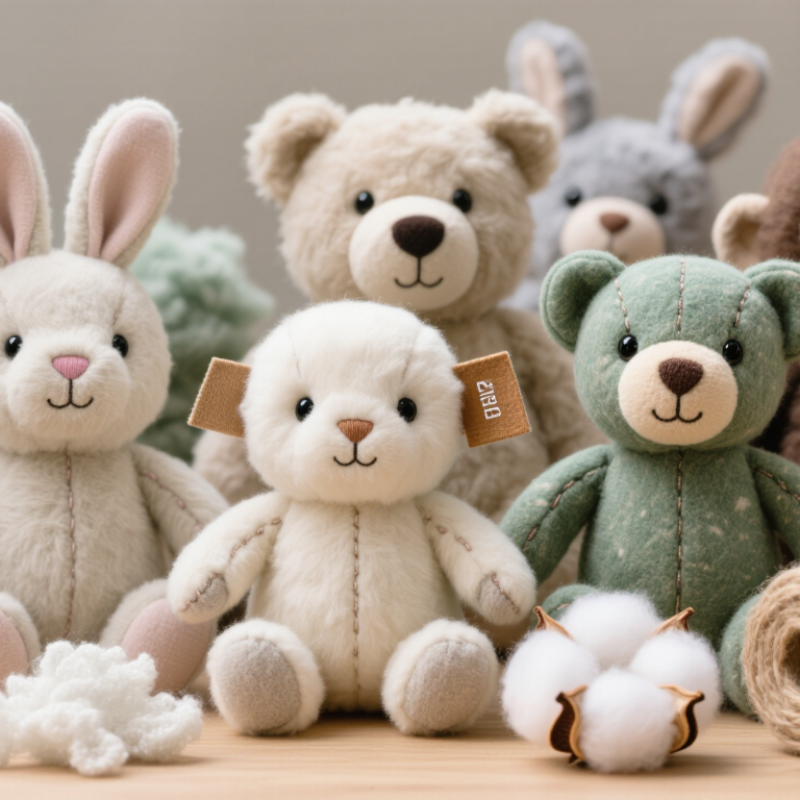
A plush toy may contain recycled polyester, organic cotton, plant-based filling, or recycled cardboard packaging. These materials sound responsible, but material names alone prove very little. ISO 14021 focuses on self-declared environmental claims. It expects claims to be specific, accurate, and supported by verifiable information.
For example, “made with recycled polyester” should identify the recycled material and its percentage. A clear product record may state that the outer fabric contains 80% recycled polyester, while the filling remains conventional fiber. That detail matters. Recycled content is not the same as recyclable design. A toy may use recycled fabric but still contain mixed fibers, plastic eyes, or glued parts that complicate recycling.
Reliable evaluation also requires lifecycle thinking. Manufacturers should consider raw materials, production waste, transport, use, and disposal. Testing documents, supplier records, and traceable calculations can support environmental claims. Still, documentation may have gaps. Small factories sometimes rely on changing supplier statements, and recycled inputs can vary between batches. That is a real weakness.
Look for measurable wording. “Contains 30% post-consumer recycled material” is stronger than “green” or “earth-friendly.” Care instructions also matter. Durable stitching, washable fabrics, and replaceable components can extend a toy’s useful life. Sustainability is imperfect here. A carefully made toy can still create waste, energy use, and transport emissions. The honest question is how clearly those impacts are described.
In 2026, eco-friendly plush toys often use recycled polyester for their soft outer fabric or filling. Some use recycled cotton blends, while embroidered details may use conventional thread. Materials can vary within one toy.
The Global Recycled Standard, or GRS, helps verify these claims. A product generally needs at least 50% recycled content to carry a GRS product label. This percentage is calculated by weight, not by appearance or marketing language. A toy may feel completely recycled, yet only its stuffing qualifies. The fabric, thread, eyes, and packaging may follow different requirements.
Traceability matters. Certified facilities must document recycled inputs from processing through manufacturing. Audits also review chemical controls, worker conditions, and environmental practices. However, a GRS label does not mean every component is recycled. It also does not prove that a toy has zero environmental impact. That distinction is easy to miss.
When checking a plush toy, ask which parts contain recycled material. Look for clear percentages and certification details. A supplier should explain whether recycled fibers come from post-consumer bottles or factory waste. I would also check stitching and wash durability, because a recycled claim means little if the toy wears out quickly. Good intentions can still produce weak products.
| Plush Toy Material | Typical Source | What It Is Made From | GRS Relevance | Key Environmental Consideration | Performance in Plush Toys | What Buyers Should Check |
|---|---|---|---|---|---|---|
| Recycled Polyester Fiber | Post-consumer plastic packaging, commonly PET bottles | Polyester polymer mechanically or chemically processed into yarn, fabric, or soft filling fiber | Eligible recycled content A finished product generally needs at least 50% recycled content to use a consumer-facing GRS product label. |
Uses existing plastic waste and can reduce dependence on virgin polyester; it remains a synthetic material and may release microfibers. | Soft, lightweight, resilient, colorfast, and suitable for stuffing, plush fabric, and embroidered details | Ask whether the recycled percentage applies to the whole product or only one component, and request valid chain-of-custody documentation. |
| Recycled Cotton | Pre-consumer textile cutting waste or post-consumer cotton garments | Recovered cotton fibers that are sorted, shredded, cleaned, and spun or blended into new yarns and fabrics | Can support GRS claims The recycled cotton percentage must be verified through the certified supply chain. |
Diverts textile waste and generally requires less new agricultural input than virgin cotton; fiber length can be shorter after recycling. | Comfortable and breathable, but usually less abrasion-resistant and less elastic than polyester unless blended with other fibers | Check the blend ratio, fabric strength, color consistency, and whether the recycled content is pre-consumer or post-consumer. |
| Recycled Wool | Post-industrial wool scraps or discarded wool textiles | Recovered wool fibers mechanically opened and re-spun or combined with other fibers | Potentially GRS-certified Certification depends on verified recycled input and documented processing stages. |
Can reduce demand for virgin animal fiber and extend textile use; mechanical recycling may shorten fibers and affect softness. | Warm and naturally insulating, but generally less suitable for washable, low-cost plush filling than recycled polyester | Check fiber composition, allergen information, washing instructions, and whether recycled wool is blended with virgin fibers. |
| Recycled Nylon | Discarded fishing nets, industrial waste, or post-consumer nylon products | Recovered nylon converted into new yarn or textile fiber through mechanical or chemical recycling | Can qualify under GRS The product must meet the applicable recycled-content and traceability requirements for the intended claim. |
Can reduce waste from durable nylon products; it is still petroleum-derived and synthetic. | Strong, durable, and abrasion-resistant; often used for plush fabric, clothing, accessories, or reinforcement | Confirm the actual recycled percentage and whether the recycled input is pre-consumer or post-consumer material. |
| Recycled Polyester Plush Fabric | Woven or knitted fabric made from recycled polyester yarn | Surface pile, backing fabric, or decorative fabric produced from recycled polyester fibers | GRS claim depends on the finished product A recycled outer fabric alone does not automatically make the entire plush toy eligible for a 50% GRS label. |
May reduce virgin synthetic fiber use, but the fabric may still include virgin yarn, dyes, coatings, thread, or trims. | Soft hand feel, flexible construction, and good suitability for colorful plush surfaces | Review the complete bill of materials, including fabric, filling, thread, eyes, labels, stuffing, and packaging. |
| Recycled Polyester Filling | Recycled PET bottles or recovered polyester textile waste | Fluffed polyester staple fiber, sometimes formed into hollow or siliconized filling | Filling alone is not enough If only the stuffing is recycled, the complete toy may not reach the 50% recycled-content threshold for a consumer-facing GRS label. |
Uses recycled feedstock and is lightweight; end-of-life separation can be difficult when the toy combines many materials. | Soft, springy, washable, and resistant to moisture and pests | Ask for the recycled percentage by total product weight, not only the percentage of filling material. |
| Organic Cotton Outer Fabric | Cotton grown under an organic agricultural standard | New cotton fiber produced without the prohibited synthetic pesticides and fertilizers specified by the relevant organic standard | Not recycled content Organic certification and GRS certification address different attributes. Organic cotton does not count as recycled material simply because it is certified organic. |
May support soil and agricultural management goals; environmental performance depends on farming, processing, dyeing, and water management. | Soft, breathable, and suitable for embroidered or printed plush surfaces | Look for a recognized organic textile certification and do not treat “organic” as proof of recycled content. |
| Regenerated Cellulosic Fiber | Wood pulp or other cellulosic feedstock, depending on the fiber type | Cellulose dissolved or processed into fibers such as viscose, modal, or lyocell | Not automatically GRS recycled content Plant-derived or regenerated does not mean recycled under GRS unless the certified input meets the applicable recycled-material definition. |
Can be made from renewable feedstock, but impacts vary with forestry, chemicals, energy, and wastewater controls. | Soft and smooth, but may require blending or reinforcement for durability in plush toys | Check the exact fiber type, forestry or textile certification, chemical management, and percentage used in the finished toy. |
| GRS-Certified Finished Plush Toy | Multiple certified materials and documented manufacturing stages | A complete toy whose relevant recycled inputs, processing, assembly, and transaction records are verified through the supply chain | Consumer-facing GRS label threshold: at least 50% recycled content by the applicable product calculation. The recycled material must be traceable through certified facilities. | Provides stronger verification of recycled-content claims than an unsupported “eco” statement, but it does not mean the toy has zero environmental impact. | Performance depends on the combined fabric, filling, thread, trims, dyes, and construction | Verify the certificate scope, product category, certificate validity, recycled-content percentage, and whether the label applies to the complete product. |
| GRS Label Interpretation | Certification and labeling information supplied by the certified supply chain | Recycled content plus requirements covering chain of custody, social criteria, chemical restrictions, and environmental management | Important distinction: materials may enter a certified recycled supply chain at a lower content level, while the consumer-facing GRS product label generally requires a minimum of 50% recycled content. | GRS verifies defined production and content requirements; it does not certify that a product is biodegradable, carbon-neutral, plastic-free, or automatically recyclable. | Does not determine softness, safety, durability, or design quality by itself; these require separate product testing. | Do not rely only on a logo. Check the certificate number, scope, product details, and the percentage and type of recycled material claimed. |
When choosing eco-friendly plush toys in 2026, check the fiber content before admiring the soft texture. Organic cotton can reduce reliance on conventional farming inputs, but “organic” should not be accepted without certification details. Under GOTS requirements, a textile product must contain at least 70% certified organic fibers to use the approved organic-content claim. Products with 95% or more certified organic fibers meet the stronger organic classification. The remaining fibers still matter.
GOTS also evaluates processing, dyes, wastewater, and workplace conditions across the supply chain. This makes certification more meaningful than a simple green label. However, a plush toy may contain polyester thread, plastic eyes, or synthetic filling. Read the material list carefully. I once assumed organic cotton covered the entire toy, and that assumption was too broad. Certification details can be easy to miss.
Tips: Look for the GOTS certification mark and a verifiable certification number. Ask whether the outer fabric and filling are certified separately. Choose tightly stitched toys with washable covers, since longer use lowers replacement waste. Avoid vague claims such as “natural fabric” without fiber percentages. Even certified cotton is not impact-free; farming, dyeing, packaging, and shipping still require energy and water. Small details deserve attention.
A 2026 eco-friendly plush toy may use recycled polyester, organic cotton, or plant-based stuffing. These materials still require careful safety testing. EN 71 is a European toy-safety series with three key areas. EN 71-1 examines mechanical and physical risks, including loose eyes, weak seams, and accessible filling. EN 71-2 evaluates flammability. EN 71-3 checks whether certain elements can migrate from materials into a child’s mouth.
ASTM F963 serves as a major United States toy-safety standard under federal requirements. It also covers mechanical hazards, flammability, and chemical limits. However, its test methods and pass criteria do not always match EN 71. ASTM testing may address sound-producing parts, batteries, magnets, and specific accessible components more directly. A plush toy with a stitched rattle still needs testing. Recycled fabric does not receive an automatic exemption.
Test records should identify the toy’s age grade, materials, seams, dyes, coatings, and internal parts. An accredited laboratory can compare the product with the applicable EN 71 and ASTM F963 requirements. Inspectors should also review production samples, not only a perfect prototype. Real-world handling is messier. A seam may pass once and weaken after repeated pulling. Testing reduces risk, but it cannot replace thoughtful design, traceable suppliers, and honest age warnings. Manufacturers should verify the latest applicable editions before sale, because standards and enforcement details can change.
2026 Best Eco Friendly Plush Toys What Are They Made From?
A credible eco-friendly plush toy starts with durability, not marketing language. Dense stitching, reinforced seams, and washable fabric can extend its useful life for years. I check stress points around ears, paws, and embroidered features. A soft toy that loses its shape after three washes creates avoidable waste. Still, durability claims need testing data, not cheerful packaging statements.
Fill materials deserve closer attention. Recycled polyester can reduce demand for new plastic, while responsibly sourced natural fibers may offer different benefits. Neither option is automatically superior. Fiber origin, processing energy, and shipping all affect the lifecycle assessment. Dyes should resist fading and saliva transfer, with clear evidence from recognized laboratory testing. I would also question bright colors that require heavy chemical processing or repeated washing.
Packaging should protect the toy without becoming a second product. Recycled paper, water-based inks, and minimal inserts are practical details. Plastic windows often complicate recovery. Recycling remains imperfect because plush toys combine fabric, thread, stuffing, labels, and sometimes plastic eyes. Design for repair helps: removable covers, replaceable stitching, and clearly identified materials matter. Many recycling systems cannot process toys locally. That limitation should be stated honestly. A take-back program may help, but transport can weaken its environmental benefit.
Lifecycle Assessment: Durability, Fill Materials, Dyes, Packaging, and Recycling
The chart shows documented material attributes rather than company or brand performance. Virgin polyester is fossil-based, recycled polyester uses recycled plastic feedstock, cotton is plant-based, and PLA is plant-based but generally requires industrial composting conditions. Actual environmental performance also depends on toy durability, seam construction, dye chemistry, packaging design, local recycling systems, and whether the toy can be repaired or reused.
It uses measurable materials, durable construction, and reduced packaging. Vague claims are weak. Check fiber percentages, supplier records, testing documents, and disposal information. Sustainability is never perfect, but clear evidence helps.
No. Recycled fabric and recyclable design are different claims. A toy may contain recycled polyester but also plastic eyes, glue, mixed fibers, and stuffing. These parts can complicate recycling.
Look for specific wording, such as “contains 30% post-consumer recycled material.” The record should identify the recycled material and its location. For example, the outer fabric may contain 80% recycled polyester, while the filling remains conventional.
A recognized organic-textile standard generally requires at least 70% certified organic fibers. A stronger classification may require 95% or more. Check whether the outer fabric and filling are certified separately.
Check the certification mark, verification number, fiber percentages, thread, filling, and plastic features. “Natural fabric” alone proves little. I once assumed organic cotton covered the whole toy. That assumption was too broad.
Durable stitching can reduce replacement waste. Inspect reinforced seams around ears, paws, and embroidered features. Washable fabric also helps. A toy losing its shape after three washes is not a strong result.
There is no automatic winner. Recycled polyester may reduce demand for new plastic. Natural fibers may have different advantages. Processing energy, fiber origin, shipping, and durability must also be considered.
Dyes should resist fading and saliva transfer, supported by recognized laboratory testing. Recycled paper, water-based inks, and minimal inserts can reduce packaging impacts. Plastic windows often complicate recovery. Bright colors may require heavier chemical processing, but this needs evidence.
Often, recycling is limited because toys combine fabric, thread, stuffing, labels, and plastic parts. Many local systems cannot process them. Repairable designs, removable covers, and replaceable stitching may extend use. A take-back service helps sometimes, but transport can reduce its benefit.
Eco-friendly plush toys are designed with both environmental impact and product safety in mind. When asking “what are eco friendly plush toys made from,” the answer may include recycled polyester, responsibly sourced natural fibers, certified organic cotton, plant-based materials, and recycled or low-impact filling. Under ISO 14021, sustainability claims should be clear, accurate, and supported by verifiable evidence rather than vague marketing language. For recycled content, the Global Recycled Standard (GRS) generally requires products to contain at least 50% certified recycled material to qualify for its certification.
Organic cotton plush toys should also be evaluated carefully: GOTS certification requires a minimum of 70% certified organic fibers, along with requirements for processing and social responsibility. Safety remains essential, so toys should be tested against relevant EN 71 or ASTM F963 requirements, including risks from chemicals, flammability, small parts, and mechanical hazards. A complete lifecycle assessment should consider durability, filling materials, dyes, packaging, and realistic recycling options, since a long-lasting toy can reduce waste over time.

Petto Toys